
Arkady Martine’s novel gets a wobbly three stars from yours truly
* This review was originally published on Goodreads
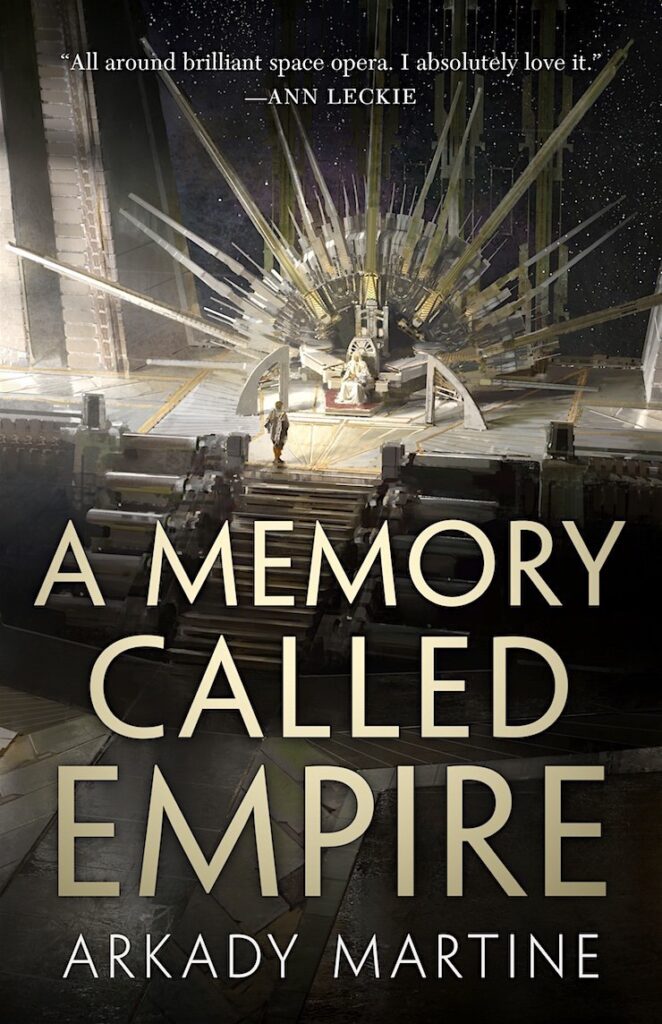
When I started reading this novel, I thought that it started strong, with vivid descriptions, a rich world, and an intriguing political / murder mystery plot. As the novel went on, however, I started noticing some issues, and I want to talk about those.
I would say beware of spoilers, but honestly, the great mystery of the “deadly technological secret” is immediately solved. The book reveals what it is from the very beginning, and even our intrepid protagonist shares it with literal intelligence agents from the semi-hostile empire within a day of her arrival. So, how much of a spoiler is this, really?
Anyway: MILD SPOILERS AHEAD
The big deadly technological secret is a so-called imago machine. It’s a little gizmo that records the memories of a person and, when the person dies, it’s implanted in the next one, basically merging them into one. It works kind of like the Trill symbionts in Star Trek: Deep Space Nine, only as a machine instead of a living being. But the principle is the same. At no point does Mahit—or the narration, come to think about it—treat this thing as an actual deadly secret, leaving me wondering what the fuss was about. It doesn’t impact the story’s resolution a lot, either, so make of that what you will.
Anyway, her imago, the one carrying the memories of her predecessor, Yskandr, malfunctions, but the memories were out of date by fifteen years. She later gets the updated version, so she has two of those in her head, sort of. It’s kind of silly because there aren’t any actual consequences to any of this, so it doesn’t really matter much.
Okay. So, I liked the setup a lot, as I did the initial descriptions of Teixcalaan, as Mahit arrives and is pretty overwhelmed by all the splendor. What I also appreciated in the beginning were the lush descriptions of not just buildings but lighting, of clothes and people and smells and foods. Mahit grew up on a cramped space station and is intimated by all that open space.
At least that’s what she tells us. And therein lies the problem.
Martine doesn’t manage to reduce the distance between the reader and the point-of-view character even once. What do I mean by that? Well, the book is written in third-person limited. That means, a narrator is talking about the protagonist’s experiences in third person: “she” instead of “I”. The perspective is limited because we only ever witness anything from the protagonist’s viewpoint. When I talk about distance, I mean that we, as readers, are not receiving the unfiltered version of Mahit’s thoughts. We are getting the version that has been curated by the narrator. The narrative distance is too big. Instead of practicing deep interiority, Martine has chosen reported interiority. That is, we are told about Mahit’s state of mind, not shown from within. An example of this would be:
“Abruptly she felt on the verge of tears”, or “She missed him so much”.
In both snippets, we are being told about Mahit’s feelings instead of experiencing them directly.
And the whole book is like that. I’ve read a bunch of one- and two-star reviews, and a lot of them lamented the fact that they couldn’t connect with the main character. I think that this “telling instead of showing” writing style is one reason why many readers feel that way. Martine does not do this on purpose, mind you. That much is very clear during the few times she attempts to write in a fragmented, chaotic way, as Mahit is experiencing some sort of distress. There’s a scene on page 354 of my Kindle edition where she’s internally communicating with the imago of her ambassadorial predecessor.
“Hello, Yskandr, she managed, thinking past the nausea. The corners of her mouth tugged into that wide smile that was his, and she chided him, gently (they were going to have to start over on so many things and oh fuck she missed her own imago), get out of my nervous system.”
This is the author attempting to convey emotion and fragmented thoughts. But it doesn’t land, because first of all, it’s still mostly bland description of something happening to someone else. Second, she barely ever does this. I mean, Mahit nearly gets murdered a bunch of times, is embroiled in interstellar conflicts that may see her home station Lsel either annexed or destroyed by an underdeveloped alien threat. She gets hurt in a bombing and receives back-alley neurological surgery. None of that seems to faze her. The narration never really changes, never gets actually frantic. The pacing is always the same. Look at this, on page 393:
“Mahit laughed. Inside her skull, behind the endless ache of the surgical site and the pulse of her blood in her damaged hand, the shimmer of damaged nerves and the endless sour ache in her hip, she almost felt good.”
I am completely unable to feel anything reading this description of someone else going through something. I am not in Mahit’s head. I am not getting the impression that she’s tired, wired, in pain. That lack of sleep and a surge of adrenaline have her feeling oddly elated. Instead, I am reading about her reacting to something to which I have no access. I am being told what Mahit is experiencing after the fact through an analytical filter. One issue is also that Martine likes to stack imagery, i.e., she overdoes it with adjectives, similes, and metaphors even when the scene does not call for it. In this scene, Mahit and her two allies have just been arrested, after fleeing agents, after Mahit got illicit brain surgery from an anti-imperialist insurgent, after running through a riot. She also has barely slept in days, and the empire is not just planning to annex her station but is also on the brink of civil war. Do you think that in this situation, the narration should be this heavily laden with adjectives? Should the pacing be this slow? Should the narration be this flowery and entirely coherent? The answer, of course, is no. What we want is somatic immersion, that is, her adrenaline, exhaustion, and panic leaking into the syntax.
We’re told Mahit is being challenged cognitively, but we’re told in a way that is cognitively demanding. She may be overwhelmed, but we as readers are confronted with a lot of complex imagery that achieves the exact opposite of what Martine is going for. Sensations are listed and endlessly qualified. None of the sensations interrupt Mahit’s thought process. The flowery language undermines any sense of urgency. And that’s just the wrong choice for this type of scene, where we should be immersed in the character’s struggles and state of mind. The reader remains at arm’s length, and that’s boring.
Martine consistently chooses reflective coherence over visceral chaos, and it doesn’t work because she overdoes it. It’s everywhere and thus loses its impact.
The main problem is that throughout the entire book, the pacing never changes. Everything is narrated the same way, so during tense scenes, there isn’t any urgency. One thing I noticed is that many writers will waste time describing a whole bunch of little things while neglecting to delve into actual characterization or using the setting as part of the story. In A Memory Called Empire, we get so many drawn-out scenes where people are eating stuff or talking about poetry, but none of that actually matters to the characters, the plot, or the themes. It’s easy to describe a building or a sandwich. It’s much harder to make them matter to the story.
People make fun of Stephenie Meyer for writing about Bella making lunch for her father, because it’s useless filler content. But even in award-winning books like A Memory Called Empire, or series that get adapted into very expensive shows like Silo on Apple+ (adapted from the Wool trilogy by Hugh Howey), you get these filler scenes that add nothing to anything and just make the whole thing drag. Hugh Howey is especially guilty of this. His Silo books have a million characters with no personality, the main plot gets resolved in the inanest way imaginable, but there are a million scenes describing lamps and machines and a stairway. It’s filler. It doesn’t matter. And yet, it’s about 40 percent of the books.
Arkady Martine does the same thing. And it’s dull.
The emotionless, dragging descriptions affect the main character the most. I mean, Mahit is joined with two imago machines and basically carries a whole bunch of people in her mind. Does it change who she is? No. Unlike Deep Space Nine had the Trill symbionts merge with the Trill hosts to create a whole new entity, Mahit just has endocrine responses and a voice in her head. That’s it. The narration muses on the different languages’ definitions of “you” and “we”, but none of this affects the protagonist. Mahit doesn’t change. She doesn’t merge with the two versions of Yskandr and all the memories he inherited in his time to form a new individual. In fact, she doesn’t change at all. At the end of the book, nothing is learned by anyone. The only thing that happens is that the original status quo is restored, oh, and there’s a vague alien threat that might be dealt with in the sequel. And that just made it a frustrating read for me.
I wouldn’t say this is a terrible book or anything. The plot is interesting but at times executed poorly. There are many questions that are left unanswered (like: What’s going on with the city’s AI? Why does a society this technologically advanced not have scanners at their spaceports to detect potentially dangerous technology? Why do they still have paper mail? Why doesn’t Mahit have any staff from home? Why is she an idiot?), which broke my suspension of disbelief a few times. And the whole thing needed a thorough line edit. The flat main character was another issue. I don’t need to hear about the five million dishes people indulge in, but I would have liked to find out more about Mahit as a person beyond her being a Teixcalaan fangirl and far too trusting for a diplomat. I know nothing about her hobbies, about her family and friends, about her fears. She doesn’t have a personality beyond being in love with the Empire. None of her actions felt natural. Instead, they served the plot and nothing else. And that’s why pacing is so intrinsically connected with characterisation. If you waste time with filler and fluff, then you won’t have enough space for the stuff that really matters.
I wouldn’t say that Martine’s stylistic choices are incompetent. The technique of intellectual elegance over sensory immersion has its place, but if you overdo it, it ends up creating a kind of narrative distance that works against emotional logic. The world Martine created has great potential. But she didn’t give the characters or the plot any air to breathe amid endless fluff and emotionless reporting. And that’s a shame, because while this book isn’t terrible, it could have been brilliant.
Leave a Reply